Lightweight composite rivets will extend service life and enhance durability of bridges, docks, and more
December 9, 2025

Researchers from Skoltech and Harbin Institute of Technology have devised and tested a new mechanism for joining together the composite parts that make up bridges, the cooling towers of power stations, water treatment facilities, marine terminals, and offshore oil rigs. The solution provides an alternative to the heavy and corrosion-prone metal bolts. The study was published in the journal Materials & Design and supported by a Russian Science Foundation grant.

“Across the country, there are dozens of bridges entirely made of fiber-reinforced composites. There’s one caveat: What holds these structures together are metal bolts, which make the construction heavier and reduce its service life. In effect, it’s often the case that the service life of the metal parts limits that of the entire construction. This is even more true for structures exposed to corrosive agents such as seawater, certain industrial chemicals, and hot steam, for example in the cooling towers of power plants,” said Associate Professor Alexander Safonov of Skoltech Materials, the principal investigator of the study.

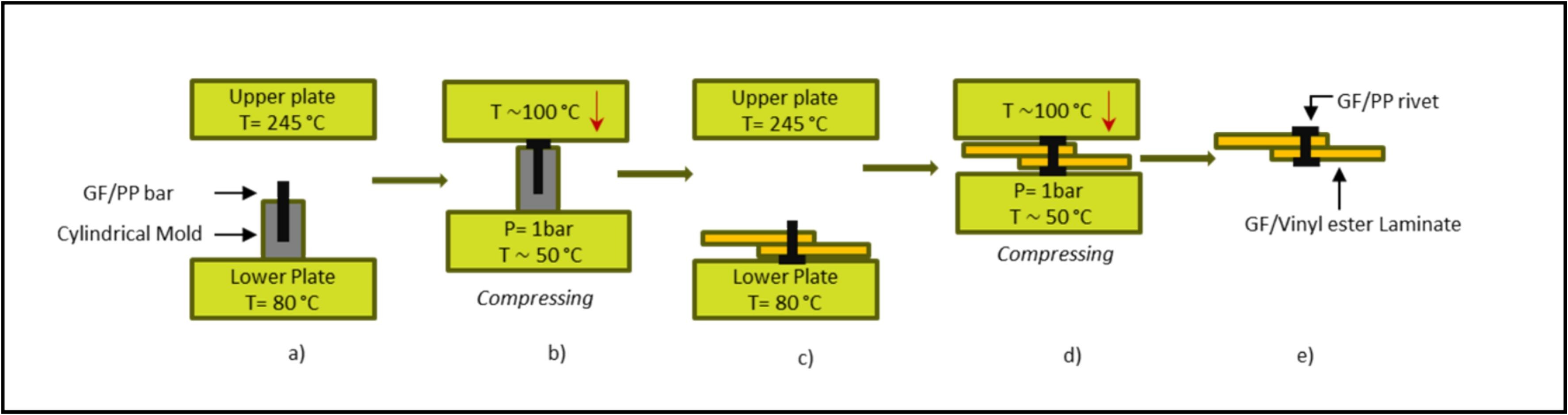
The team behind the study proposed that bolts be exchanged for rivets made of glass fiber-reinforced polypropylene. While the composite profiles that make up the bridge or other structure are made using thermoreactive polymers that harden once and will not change shape when reheated, the rod-shaped thermoplastic rivets can penetrate two profiles and then be secured by being melted and flattened at both ends.

subscription
Image. Side view: A thermoplastic rod (black) is shaped with a hot press (green) and a cylindrical mold (gray) and used to join together two rectangular profiles (yellow). Credit: Salim Makeera et al./Materials & Design

The rivets are manufactured by pultrusion, a technique that involves dragging the reinforcing fibers soaked in polymer through a hot narrow canal of the appropriate shape called a draw die, followed by hardening. 

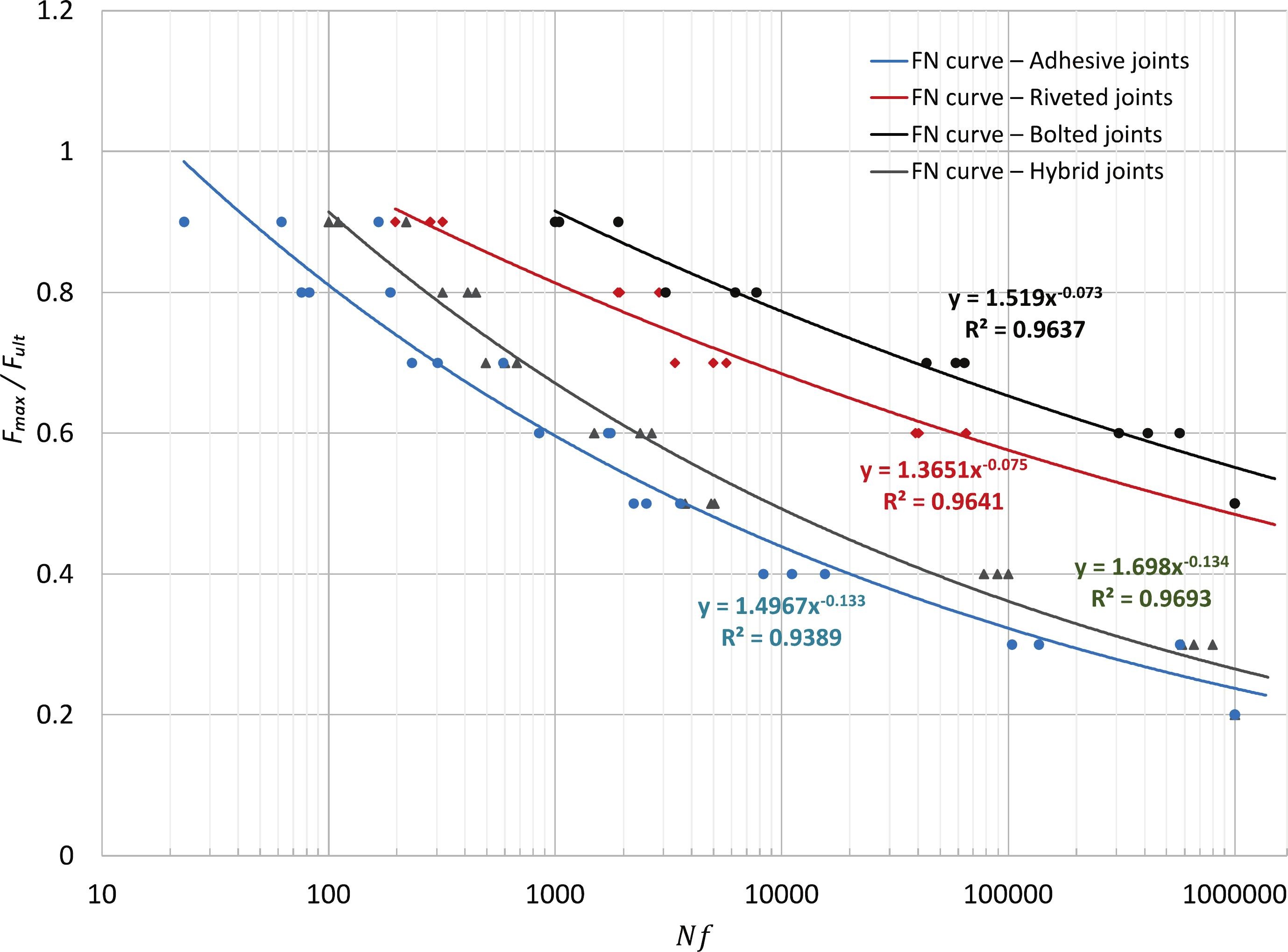
The researchers conducted tests to measure the mechanical strength of the resulting joint. These tests revealed the ultimate load that breaks the joint, as well as the number of loading and unloading cycles that the structure can withstand at 20%-90% the ultimate load. Three similar experiments were done on analogous specimens joined by bolts, glue, and glue and rivets together.

subscription
Image. Test findings. Vertical axis: The applied load, where 1 is the ultimate load breaking the joint, 0.2 is 20% the ultimate load, etc. Horizontal axis: The number of loading and unloading cycles before the joint fails (on a logarithmic scale). The curves represent the bolt joint (black), the rivet (red), the rivet and glue (gray), and glue (blue). Credit: Salim Makeera et al./Materials & Design

The test findings confirm that the rivet joint proposed by the team reduces the weight of the structure and eliminates corrosion issues. These data can be used in the design of composite-only constructions without metal parts: docks, bridges, containers for transporting hazardous chemicals, and others.