Researchers from Skoltech, SberUniversity, the M.N. Mikheev Institute of Metal Physics of UB RAS, and Ural Federal University have published a review on a novel approach to interpreting chemical bonding in solids. The method not only describes crystals in terms of precise calculations, but also enables chemists to reclaim explanatory models that are intuitively meaningful to them. The insights that emerge span long-documented anomalies that previously lacked a theoretical account. This review paper came out in Russian Chemical Reviews.
A key challenge in modern computational chemistry is the gap between accuracy and interpretability. The most rigorous description of a material’s properties is given by its many-electron wave function. It can be obtained by solving the Schrödinger equation, but even for a system with a mere 10 electrons, the solution is an abstract mathematical object in 30-dimensional space. While it allows the observable parameters to be calculated, it does not really answer conceptual questions: How are electrons redistributed between the atoms? What is the actual nature of a particular bond?
For an intuitive picture, chemists traditionally rely on the concept of orbitals and on qualitative characteristics such as ionicity, covalency, and charge transfer. In crystals, however, this becomes problematic: Orbitals in crystals are “smeared out” across many atoms and depend on the wave vector, which gives rise to an infinite number of orbitals belonging to one family (a “band”).
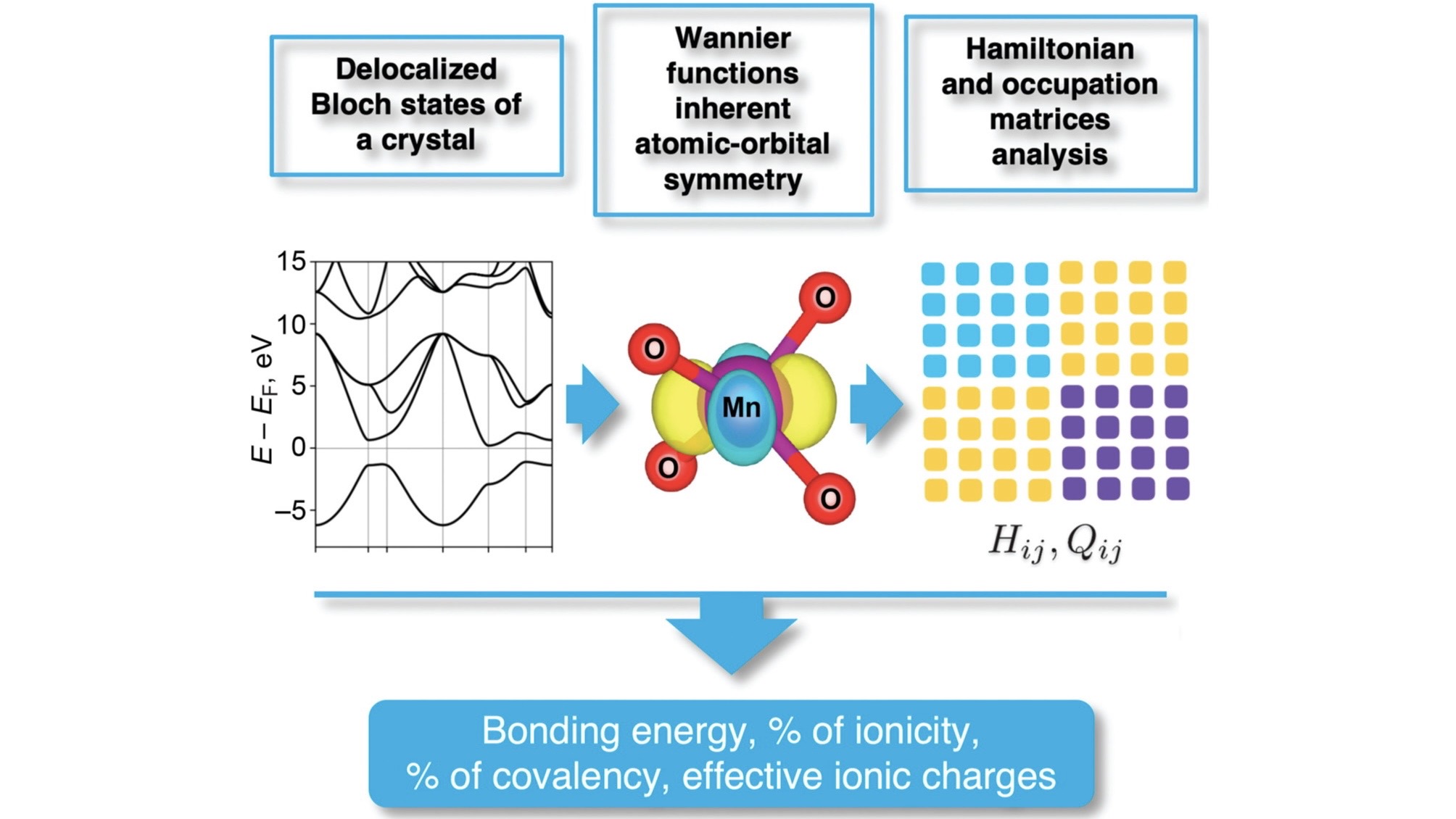
A method for overcoming this challenge emerged back in 1937, with the introduction of Wannier functions. They make it possible to return from wave-vector space back to orbitals that are well localized around individual atoms. The research team is developing a particular approach to constructing Wannier functions, whose projection onto atomic orbitals yields functions that are not only well localized but also preserve the symmetry of the original atomic orbitals.
“Different authors define Wannier functions differently. Some use maximally localized functions,” explains study coauthor Distinguished Professor Artem Oganov, who heads Skoltech’s Materials Discovery Laboratory. “We, on the other hand, project Wannier functions onto atomic orbitals. This approach enables us to interpret chemical bonds in terms of abstractions that make sense to a chemist — charge transfer, ionicity, covalency — while still relying on the results of rigorous, nonempirical calculations.”
Building on a method first proposed by Professor Vladimir Anisimov, the researchers show how it can be used to calculate atomic charges in crystals, isolate individual bonds, compute their energies, and determine the relative contributions of ionic and covalent interactions.
As the review emphasizes, this kind of analysis sheds light on nontrivial experimental facts that, while previously known, had gone unexplained. In particular, it accounts for the inverted charge distribution in boron phosphide crystals. It had previously been established that, contrary to what electronegativity would predict — namely, that phosphorus should pull electrons away from boron — it is in fact the boron atoms that acquire a negative charge in this compound. This counterintuitive finding had already been confirmed by earlier calculations, but only the Wannier function-based approach proposed in the new paper made it interpretable in terms of clear and meaningful chemical notions, reconciling the quantitative analysis with conceptual models of the material.