Researchers uncover how multilayer nanocoatings dissipate energy at the nanoscale to prevent failure
August 13, 2026

An international research team featuring Professor Alexander Korsunsky from the Skoltech Engineering Center has, for the first time, performed direct measurements of mechanical stresses at the contact between a diamond indenter and a complex nanostructured coating with a resolution of under 80 nanometers. Using synchrotron X‑ray nanodiffraction at the ESRF facility in Grenoble, the scientists showed that a multilayer coating made of ceramic ZrN with amorphous ZrCu interlayers dissipates elastic energy 30% more effectively than its monolithic counterpart, preventing crack propagation. The findings provide engineers with direct quantitative criteria for designing next‑generation protective coatings and have been published in the journal Communications Materials (Springer‑Nature).

In reality, contact between solid bodies never occurs over perfectly flat surfaces but through countless microscopic asperities. At these points, stresses can reach tens of gigapascals, leading to local deformation and catastrophic failure. This is particularly critical for protective coatings on cutting tools, turbine blades, and biomedical implants, where contact loads are compounded by high temperatures and aggressive environments.

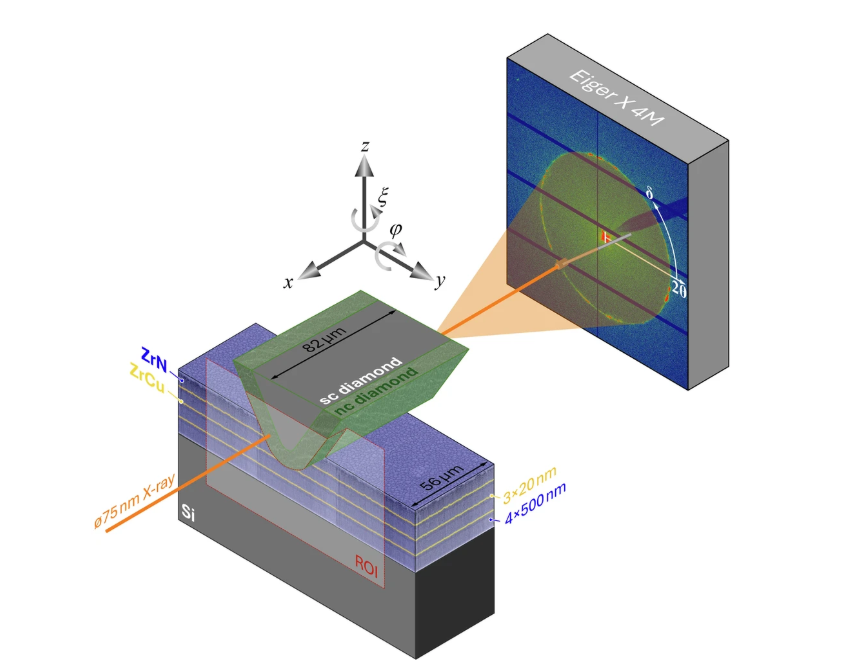
Until now, researchers could measure stresses either in the coating or in the indenter, but never simultaneously. Traditional methods only provided averaged pictures with resolutions of tens of microns, while computer simulations relied on assumptions that experiments didn’t always confirm. To overcome this barrier, the team developed a unique nanomechanical probe: a single‑crystal diamond indenter coated with a 3.8‑micron layer of nanocrystalline diamond. This allowed them to simultaneously record diffraction signals from both the indenter and the coating. By scanning the contact area with an 80‑nm step, they obtained stress distribution maps with unprecedented detail.

subscription
The probe consists of a single‑crystal diamond tip coated with nanocrystalline diamond via chemical vapour deposition. It was placed in contact with a thin multilayer ZrN‑ZrCu film under constant load, while a 75‑nm X‑ray beam scanned a region of interest measuring 20 µm by 12 µm. At each loading step, 37,500 two‑dimensional Debye‑Scherrer diffractograms were recorded. Image source: How interfaces limit nanoscale stress concentrations and prevent catastrophic failure in single-asperity contacts.

In the single‑layer coating, compressive stresses under the indenter reached –13.4 GPa, and tensile stresses appeared at the interface with the silicon substrate, triggering cracks. In the multilayer coating, the picture was fundamentally different: stresses remained compressive throughout the entire thickness, peak values were reduced, and tensile stresses at the substrate virtually disappeared. Moreover, the zone of intense deformation was broader — the load was distributed over a larger volume. The key mechanism is that the amorphous ZrCu interlayers, being less rigid and capable of plastic deformation, shield the transmission of stresses between the ZrN layers. This works much like the soft organic layer between mineral plates in nacre, which prevents crack propagation. As a result, the multilayer coating stored only 69% of the elastic energy compared to the single‑layer version — the remaining 30% was dissipated through plastic deformation of the interfaces.

These findings give engineers solid numerical benchmarks for designing protective coatings of the next generation. For cutting tools, this could increase service life by two to three times by suppressing crack initiation; for gas turbine blades, it could enhance durability under high‑temperature oxidation and thermal cycling; and for biomedical implants, it could reduce wear and fretting damage. In addition, the technique developed here is set to become a reference tool for validating computer models of contact mechanics, accelerating the development of new materials.

“Imagine trying to understand how pressure is distributed at the contact point between two solid bodies,” commented co‑author Professor Alexander Korsunsky from the Skoltech Engineering Center, the head of the Laboratory for Hierarchically Structured Materials. “Previously, we could only measure what was happening inside either one body or the other — but never both at once, and with much poorer resolution. Now, using the latest advances in synchrotron methods, we’ve shown that ultrathin metallic films in multilayer coatings redistribute and dissipate stored elastic energy, acting like damping interlayers. This isn’t just a breakthrough in resolution — we’re giving engineers a way to directly measure stresses at the level of individual asperities in real contacts, providing a toolkit that Boussinesq, Hertz, and even Greenwood and Williamson could only have dreamed of.”