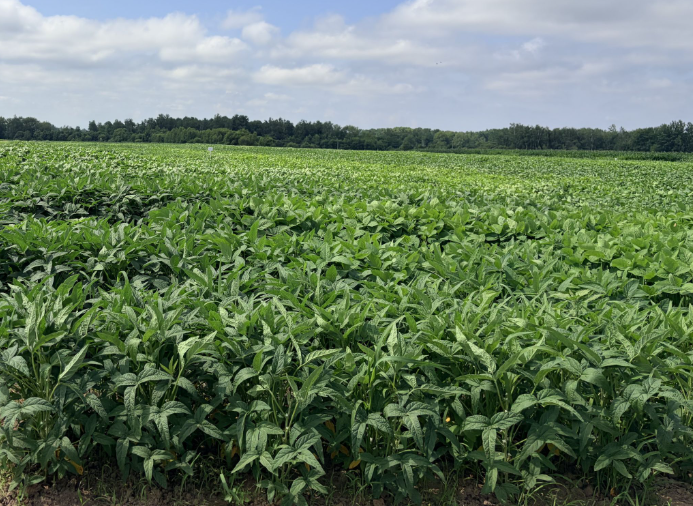
Soybean production has expanded rapidly in Russia. The area planted with the crop has more than doubled over the past decade to around 4 million hectares, while the 2023 harvest reached a record 6.6 million tonnes. The Far Eastern Federal District accounts for about 38% of national soybean production.
The Russian Far East, however, presents breeders with a difficult climatic constraint. Its short frost-free period means soybean must mature before autumn frosts arrive, making early maturity a major regional breeding priority. But shortening the growing period can limit vegetative development. Smaller plants may produce fewer branches and pod-bearing nodes, while shorter plants can also carry their lowest pods closer to the ground, where they may fall below a combine harvester’s cutter bar.
“The challenge is not simply to make soybean mature earlier,” says Yawar Habib, a junior research scientist at the Skoltech Biomed Technologies Center, the first author of the study, and a Skoltech PhD graduate from the Agrobiotechnologies and Engineering program. “The plant also needs enough architecture to support pod formation and to be harvested efficiently. We wanted to find out whether early maturity could be combined with a taller, better-branched and more harvest-friendly plant type.”
The study revealed an important opportunity for soybean breeding in the Russian Far East. While larger plants generally tended to mature later, branching was much less closely related to maturity. This suggests breeders may be able to develop better-branched plants with more pod-bearing sites without necessarily extending the growing season.
“This study is part of a broader effort to improve soybean for the Russian Far East,” Habib says. “We want to combine regional breeding expertise with modern statistical approaches and make these selection tools part of routine breeding practice. Our aim is to accelerate the development of soybean varieties better adapted to Far Eastern conditions.”
“For breeders, the value of this work is that it turns a complex set of traits into a clear selection strategy,” says Professor Elena Potokina, the lead author of the study, who heads research in agrobiotech at the Skoltech Biomed Technologies Center. “The next step is to evaluate these promising genotypes more widely across locations and seasons and determine how well the selected architecture translates into yield and harvesting performance under regional conditions.
The selected genotypes provide promising material for breeding soybean cultivars that combine early maturity with taller stature, stronger branching and improved suitability for mechanical harvesting.