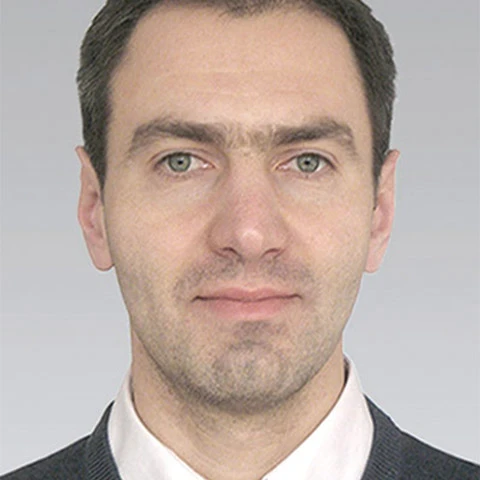
Alexey Mikhailovich Yashchenok, Doctor of Physical and Mathematical Sciences, Associate Professor at the Center for Photonics and Photonic Technologies, Skolkovo Institute of Science and Technology.
Alexey M. Yashchenok received his bachelor's degree (2002) and master's degree (2004) from the Physics Department of Saratov State University in 2004, majoring in Electronics and Microelectronics. He received his PhD in Physics and Mathematics in Solid-State Electronics, Radioelectronic Components, Micro- and Nanoelectronics, and Quantum Devices (2007) and his Doctor of Physics and Mathematics in Biophysics (2017) from Saratov State University.
Since 2007, he has worked in the Department of Semiconductor Physics, Faculty of Nano- and Biomedical Technologies, Saratov State University, as an engineer, and from 2009 to 2012, he held the position of Associate Professor.
Since 2010, he has worked as a research fellow at the Max Planck Institute for Colloids and Interfaces (Potsdam, Germany).
From 2014 to 2017, he headed a research group in the Laboratory of Remotely Controlled Theranostic Systems at the Institute of Nanostructures and Biosystems at Saratov State University.
In 2017, he joined the Center for Photonics and Photonic Technologies at the Skolkovo Institute of Science and Technology as a leading research scientist, and since 2023, he has held the position of Associate Professor.
He has been a recipient of a scholarship from the German Academic Exchange Service (2009), a scholarship from the Alexander von Humboldt Foundation (2012), and a fellowship program from Ghent University (2019). He is the co-founder and CEO of TetraQuant (2019).
He has authored over 60 scientific publications in peer-reviewed journals, two book chapters, two textbooks for undergraduate and graduate students, and is a co-author of four patents. His research results have been presented at international and Russian conferences. He has supervised two PhD theses, seven master's theses, and seven bachelor's theses.
His research interests include the creation of optical biosensors based on fluorescence and Raman spectroscopy, the creation of functional nanostructured materials, and the diagnosis and monitoring of diseases using a liquid biopsy approach.